

Same schema, different behavior
You have an agent that records benchmark results into your team's comparison table through one tool, record_result. Its arguments are a benchmark name, a metric, a numeric value and a source reference. It works on one provider. A teammate wants to try another, for cost or latency, and says, "Both take JSON Schema for tools, so switching is a config change."
Half of that is true. The schema itself travels. The book's Chapter 14 shows the conversion: an MCP tool's inputSchema becomes the function's parameters unchanged, and on Claude's API the same schema goes under input_schema. What does not travel is how each model uses the tool: which tool it picks, what argument values it produces, when it declines to call a tool at all, and what the tool text costs in tokens.
So portability is not a property you can read off the schema. It is a claim you test with an experiment.
What Chapter 14 measured
Chapter 14 offered the same tools, in the same function-calling shape, to three small local models through Ollama and to Claude Haiku 4.5 and Claude Sonnet 5.5 through the Messages API, with 24 requests per condition. Three of its findings bear on portability.
The same tool costs different tokens. Each native tool added about 39 prompt tokens on qwen2.5, about 55 on Claude Haiku 4.5 and about 74 on Claude Sonnet 5.5, whose newer tokenizer splits text more finely. For a 20-tool catalog, that is roughly 780, 1,100 and 1,480 tokens before the request says anything. Your per-attempt cost, and your prefill latency, depend on the provider even when the schema is identical.
The same catalog routes differently. With 64 tools, qwen2.5:1.5b routed 14 of 24 requests to the right tool, while both Claude models held between 22 and 24 of 24 at every catalog size. The schema was the same. The behavior was not.
Every model sometimes answers in words instead of calling a tool. Across 216 native answers per model, it happened between 5 and 33 times. In an agent loop, a text answer ends the turn, so a declined call looks like a reply, not an error.
The chapter also notes a practical difference: Claude Sonnet 5.5 accepted no temperature setting in that run, so "same sampling configuration" was not available across all five models. A portability experiment has to record such differences rather than assume them away.
Keep one strict contract, and thin adapters
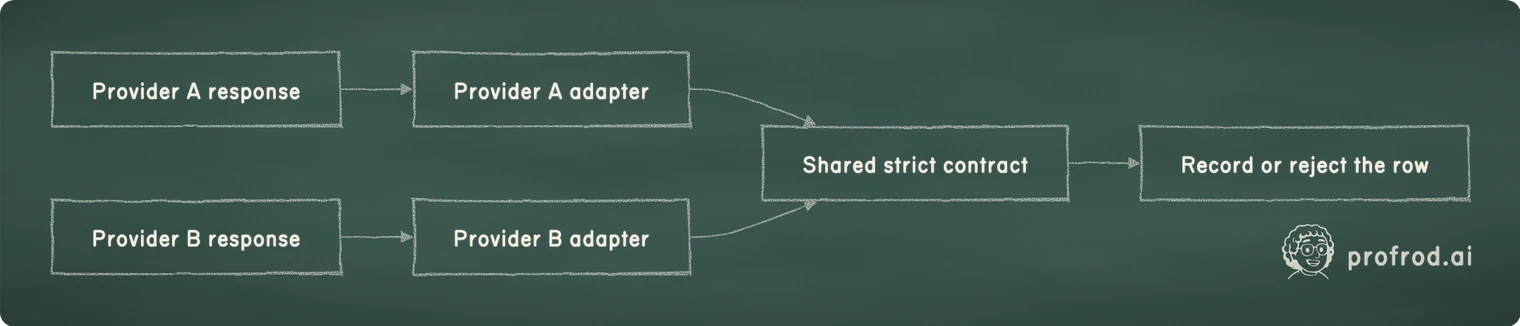
Put the stable part in one place: a strict contract for a result row. The book's Chapter 2 builds this kind of validator with Pydantic, configured with extra="forbid" and strict=True, so a numeric string like "0.713" is rejected rather than converted and an unexpected key is an error rather than silently dropped.
On each side of that contract sits a provider adapter: code that turns the provider's response into a plain dictionary for the contract to validate. The adapter is supposed to be provider-specific. It must not make decisions for the contract.
Here is a designed teaching case, not a run against any live API. Four raw payloads go through two adapters that make different choices:
| Case | Raw value from provider | Adapter A passes on | Adapter B passes on | Strict contract verdict |
|---|---|---|---|---|
| Clean number | 0.713 | 0.713 | 0.713 | accepted |
| Numeric string | "0.713" | 0.713 (coerced) | "0.713" | A: accepted; B: rejected |
Extra field verified: true | present | dropped silently | passed through | A: accepted, field lost; B: rejected |
| Tool call refused | refusal message | provider_refused | empty success payload | A: refusal surfaced; B: false success, rejected only if required fields are checked |
Scroll horizontally to view columns.
Rows two and three show the problem. Adapter A's coercion means its pipeline never exercises the rejection path Adapter B's does, so the two providers look equally clean while one of them sends strings. Adapter A's dropped field was a model asserting that it verified the number, a claim the application should see and reject. Row four is worse: an adapter that turns a refusal into an empty success destroys the one signal that says nothing was recorded.
A runnable version of the table, standard library only, makes the rule testable:
REQUIRED = {"benchmark": str, "metric": str, "value": float, "source_ref": str}


def strict_contract(row):
    if not isinstance(row, dict) or set(row) != set(REQUIRED):
        return "rejected"
    for key, kind in REQUIRED.items():
        if type(row[key]) is not kind:
            return "rejected"
    return "accepted"


def adapter_a(raw):  # coerces and drops, which hides information
    if raw.get("refused"):
        return "provider_refused"
    row = {k: raw[k] for k in REQUIRED if k in raw}
    if isinstance(row.get("value"), str):
        row["value"] = float(row["value"])
    return row


def adapter_b(raw):  # passes values through unchanged, but hides refusals
    if raw.get("refused"):
        return {}
    return dict(raw)


base = {"benchmark": "long-context-qa", "metric": "accuracy", "source_ref": "Table 3"}
cases = {
    "clean number": {**base, "value": 0.713},
    "numeric string": {**base, "value": "0.713"},
    "extra field": {**base, "value": 0.713, "verified": True},
    "refused": {"refused": True},
}
for name, raw in cases.items():
    verdicts = []
    for adapter in (adapter_a, adapter_b):
        out = adapter(raw)
        verdicts.append(out if isinstance(out, str) else strict_contract(out))
    print(f"{name:15} A: {verdicts[0]:17} B: {verdicts[1]}")
It prints accepted for both on the clean number, accepted against rejected for the numeric string and the extra field, and provider_refused against rejected for the refusal. Correct adapters keep the raw value, surface refusals as their own outcome, and leave every accept-or-reject decision to the contract.
Three failure kinds an adapter must keep apart
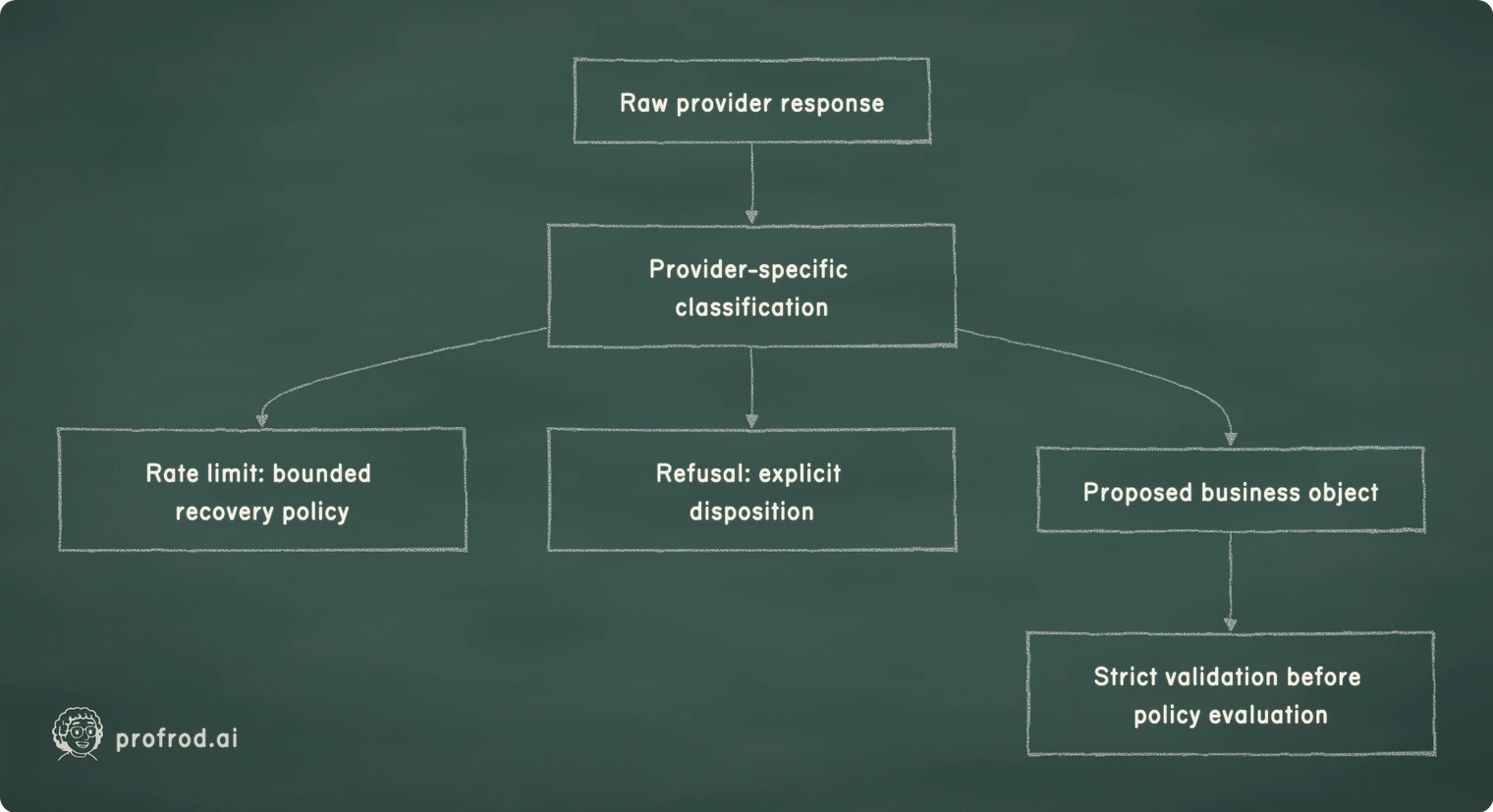
The provider is not saying the request was wrong. A bounded retry with backoff is appropriate if the operation is safe to repeat.
A deterministic validator rejects the same invalid value again. Regenerating may produce a different value, but any repair must be bounded and revalidated.
A refusal must reach your code as its own outcome, never as an empty result that reads as "nothing to record".
These three codes are categories your application defines; no provider guarantees those names. Before writing a real adapter, map each provider's actual error fields and exception types to them from its current documentation.
The portability experiment
Here is the protocol. It is written for you to run; this article reports no results from it.
One tool schema, byte for byte, for every provider. A fixed set of requests, including some where the right answer is to decline, and a grader that checks the tool chosen, the argument values and the outcome.
Model identifier, sampling settings each API accepts, the tool field it uses, and anything it does not support. Where settings cannot match, say so in the results.
Store the raw response next to the adapter's output, so a reviewer can see whether information was lost before the contract ran.
The right-tool rate, the contract-valid argument rate, the no-tool-call rate, and prompt tokens per request.
Each request ran on both providers, so read the discordant requests, as with McNemar's test in Chapter 16.
Size the experiment honestly. Chapter 14 used 24 requests per condition, and notes that a 95% Wilson interval around 0.75 then runs from 0.55 to 0.88: differences smaller than about 0.2 are within the noise of one run. To compare two providers that are both near 0.9, you need hundreds of requests, not dozens. Chapter 16's table gives the numbers.
For the related question of where state lives when the tool is served over MCP, see state and identity behind a stateless MCP server. For turning per-provider acceptance rates into a routing decision, see routing by cost per accepted outcome.
The four-case script shows your adapter code branches as intended. It says nothing about what a provider returns today under a rate limit, a refusal or a malformed call. Those are facts the provider controls; check them against current documentation and monitored test calls.
Check the decision
Why this matters in a lab
Research and applied teams move between models constantly: a new internal checkpoint, an external provider for comparison, a smaller model for cost. Tool-using agents are only as portable as their tool contract, and the contract is only as portable as the evidence behind it. A team will expect you to separate what the schema guarantees from what a model does with it, and to turn "it should work on the other provider" into a paired experiment with intervals. An interviewer might ask, "We want to evaluate our agent on three model providers. How do you make the comparison fair?" A strong answer freezes the schema and requests, records configuration differences that cannot be matched, keeps adapters from hiding information, and reports each rate with its interval.
What would prove this wrong
If two providers produce the same tool choices, argument values and refusal behavior on a large, varied request set, the adapters are thin, and the token costs are acceptable, the tool is portable for that request set, and the claim should be stated that narrowly. If your numeric rules change with the provider, as in if provider == "b": allow a string value, the provider has leaked into the contract. And providers change their APIs and documentation on their own schedule: this article's account reflects the book's recorded runs and pages checked for it, and a migration decision should recheck both.
See the full tool-selection experiment across five models, with its receipts, then build a bounded MCP client that decides what runs.


