Week 0: The Agent That Reported Work It Never Did
Prerequisite: none. This is a five-minute orientation. After this, you can: decide whether this course is worth your time, and know what each lesson will ask of you.
A report is not a result
Ask an agent to evaluate a model on a 200-case test set and write the pass rate into your results table. It comes back with a tidy sentence: the model passed 175 of 200 cases, 87.5%. The sentence is well formed, the arithmetic inside it is right, and nothing ran. The agent had no tool that could execute the harness, or it had one and chose to answer in words instead.
That failure is not hypothetical. The book's Chapter 3, The agent loop, records a real run in which a model asked to prepare replenishment drafts looked up the stock correctly, described exactly what should be ordered, and never called the tool that creates a draft. The loop reported success. Chapter 1 shows the simpler version: a response envelope that parses perfectly can carry the sentence "I placed the supplier order" when the program has no way to place one. The live class this course was first taught in saw it too: a small model, asked to confirm a booking as the last step of a plan, replied that the reservation was secured, with no tool wired to it at all.
A language model asked for text that describes a completed action produces text that describes a completed action. Whether anything happened is a property of the system around the model: which tools exist, whether their results are recorded, and whether anyone checks the claim against the record. This course is about that system.
Who this course is for
You are preparing for a member-of-technical-staff role in applied AI or research at a frontier lab, or you already work on a large AI team and want the parts of agent engineering that interviews and work samples probe. You might be an engineer building with models today, a researcher or PhD student, or earlier in your career and deliberate about what you learn.
What those roles expect, in this corner of the field, is the ability to reason about an agent quantitatively: why a long context loses facts, what a session costs, how reliability decays over a task, when a second agent pays for itself, and how to measure each of those with an error bar rather than assert it. This course teaches that.
How each lesson works
Every lesson follows the same pattern, so you always know what you are being asked to do.
The math is on the page: softmax dilution, cache break-even, pⁿ and its error bar, the cost of a tool catalog. Short, and checkable with a calculator.
The book at /book builds a working agent from scratch across 21 chapters, with every measurement recorded. Each lesson names the chapter that derives or measures its idea, and adds what the chapter leaves out.
The strongest lessons end in a protocol: a few Colab cells, on Python 3.12, that run the experiment on a real model and print a table with intervals. Most cost under a dollar at list price. Keep the notebooks; they are the kind of evidence a work sample asks for.
Where a lesson reports what the live class saw, it says so, and says that it was one run. Where nobody has measured something yet, the lesson says that too, and hands you the protocol.
The five weeks
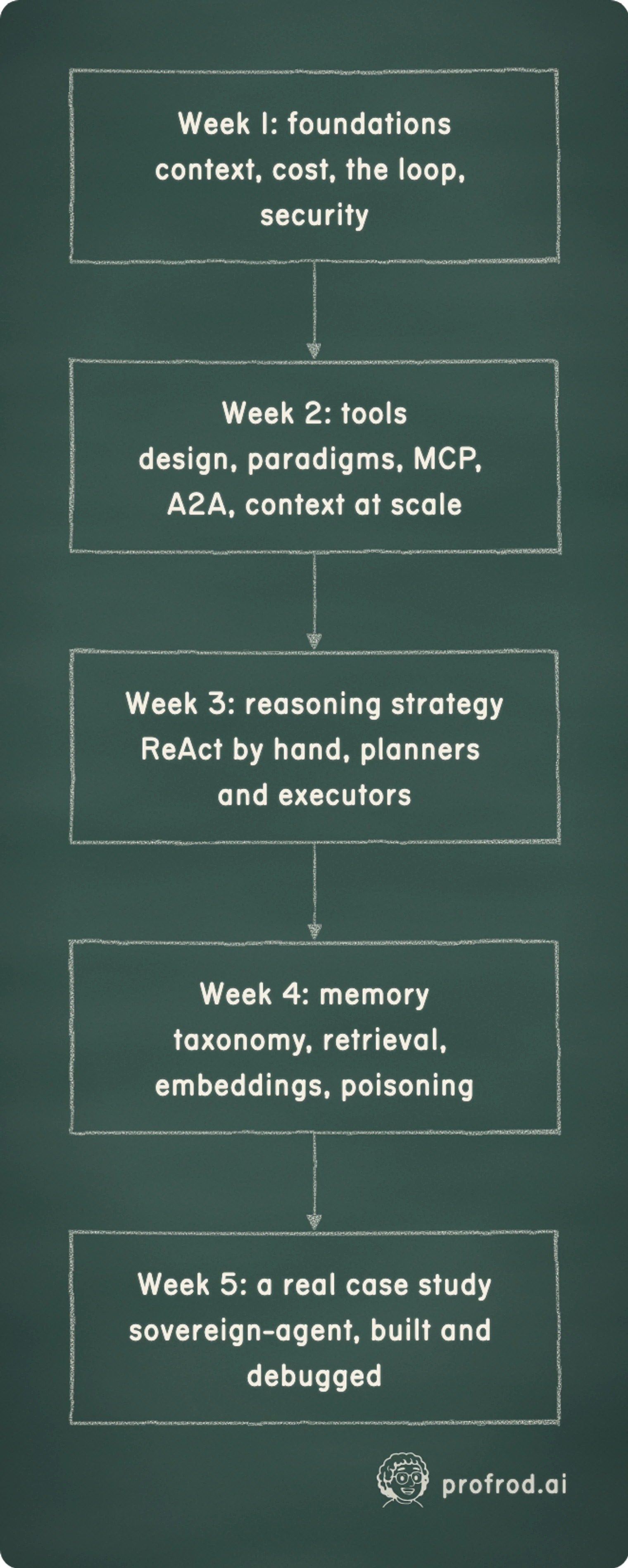
Week 1 builds the vocabulary and the three pieces of arithmetic everything else uses: attention dilution, cost, and compounding reliability. Week 2 makes tools real, from a subprocess wrapper to the Model Context Protocol. Week 3 adds strategy: why a reactive loop fails on long tasks and what a planner changes. Week 4 is memory, where retrieval quality becomes a measurement problem. Week 5 is one real framework, sovereign-agent, built and debugged in the open, and the gap between "it ran" and "it worked."
If you want a quick read on where you stand first, the lab-readiness check takes a few minutes, and the study-plan builder places this course among the others.
From model to agent: the one-sentence test for whether a system acts, and the two ways to build one.
Reply here and it goes straight to Rod. Same as replying to one of his emails.