Why This Course: The Gap Behind Klarna and Project Vend
You've read a version of this pitch before: AI is changing work, here's a course about it. That pitch is cheap. This one is checkable before you spend a minute on Class 1.
Every other course on this subject teaches you to use a tool. This one hands you a live, running semester in which your own business is the case study. By the end you'll have shipped something a stranger paid for, with your own numbers to prove it worked or didn't. That's the actual grade, not a metaphor for one.
The gap this course closes
Klarna announced its AI assistant was doing 700 people's jobs in 2024, then started rehiring humans for the same work in 2025 (Klarna's own statements and press coverage, not an independent audit; treat the headline number as the company's claim, not a verified figure). Separately, Anthropic put an AI in charge of a real shop with real money; it ended the month selling below cost, having invented a payment account that didn't exist (documented in Anthropic's own published account of the experiment). Class 1 walks both cases in full, with sourcing.
Here's the pattern underneath both: a system got handed the work, it failed somewhere nobody had specified a limit, and the postmortem blamed the model. Neither failure was really about the model being unable. Both were about nobody deciding, in advance, what the system was allowed to do without a human signing off.
That's an organizational gap, not a technology one, and waiting for a smarter model doesn't close it. A firm exists because organizing work inside it used to be cheaper than contracting it out. That cost fell toward zero for a whole class of work, and almost nobody has redesigned around the new number. You have a real, recurring task sitting in your own week right now that nobody's gotten around to fixing properly. That task is where this semester starts.
What you'll be able to do
| By demo day, you can | Instead of |
|---|---|
| Sort any task into by-hand, agent-assisted, or agent-run, and defend the call with a number | Guessing which tasks are "ready" for AI |
| Point to a real time baseline on your own workflow, measured before you touched an agent | Trusting your memory of how much faster something felt |
| Show a payment link, a stranger who paid, and a dated journal of what you tried | Describing a project that never actually shipped |
Scroll horizontally to view columns.
None of that requires programming experience to start. It requires one real task you're willing to measure honestly.
The diagnosis this course keeps making
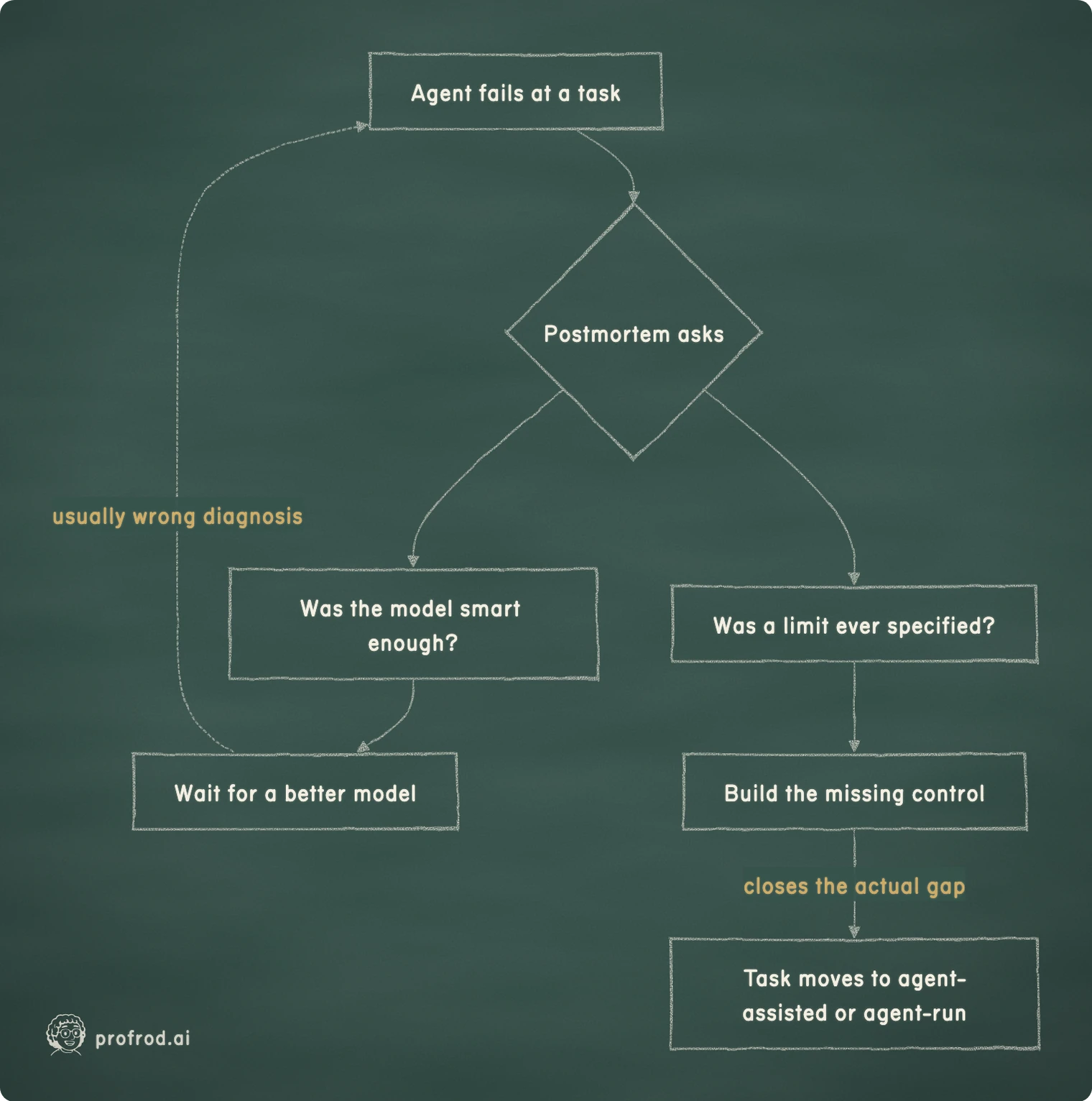
Most rooms default to the left branch. This course spends Class 1 showing why the right branch is the one that actually holds up against Klarna and Project Vend, and every week after that builds the habit of checking your own work against it.
Before you start Class 1
Not a hypothetical. The actual recurring thing in your own work that nobody's gotten around to fixing properly.
Class 1's lab has you time that task by hand, in real minutes, before anything gets automated. Block the time now.
If the task you're picturing is something you'd never actually pay to have done, it's not the one. Pick the real one.
Why 2026 specifically: the full Klarna and Project Vend cases, and the asymmetry between coordination and judgment this semester is built on.
Reply here and it goes straight to Rod. Same as replying to one of his emails.