The factory's first control
A dark software factory is only as good as its controls, because no person reads each change on the way out. profrod.ai is built by one: zeo, a factory that applies the pattern beyond software, to the site's records, reviews and releases as well as its code. One operator directs several agent streams, and each stream works under a written statement of work (SOW): a markdown file that says what the work is, where it stands, and how anyone would know it is finished. The stream that wrote this revision has filed nearly seventy of them.
The first thing such a factory has to control is the oldest failure of coding agents: they are fluent at saying they are done. Devin, Factory's Droids and every agent in this site's factory will report success. The control is to make every claim of progress carry the check that would confirm or refute it, and to refuse the claims that do not.
Why a claim needs its own check
Suppose each handoff in a chain of agents passes along a claim that is right with probability p, and the claims fail independently. The chance that a chain of n handoffs is right all the way through is
P(all right) = p^n
0.95^10 = 0.599
Ten handoffs that are each right 95% of the time are all right about 60% of the time. The book's delegation chapter measures the same compounding across subagents. You cannot fix this by making the final reviewer more careful, because by the time the chain reaches the reviewer the evidence of which step went wrong is gone. You fix it by checking each claim where it is made.
That is the idea behind one line in every SOW on this site:
done_when: "<a command or observable condition> -> <the result that means finished>"Two real stopping conditions from this site's records
Here is the done_when from the SOW that chartered this site's article publication gate, the rule
that keeps a scheduled article hidden until its date:
A controllable-clock Site test proves that an article with a future Europe/London publishedAt is denied at its canonical route and absent from every enumerated discovery surface, then becomes available at its publish instant; invalid or ambiguous publication data fail closed; make verify exits 0.
A machine can check that one. It names a test, what the test must show, and an exit code.
Here, paraphrased, is the done_when on the reconnaissance SOW that started this rewrite: the
operator has a verdict for every article, course, note and route, grounded in the files themselves,
and an ordered plan. A person checks that one. It is still a stopping condition, because it says
what must exist, but nobody can run it.
Both are honest. The difference matters: the first can be re-checked by anyone at any time; the second depends on the judgment of the person reading it. A research team faces the same choice when it writes down what "the experiment is done" means.
What the tool checks, observed on September 30, 2026
The records on this site are checked by a command-line tool called zeo, published on PyPI as
zero-employee. Check PyPI for the version you will get.
Everything below was run on this site's build machine, where zeo --version reports zeo 0.13.0,
in a throwaway folder.
uv tool install zero-employeeThe tool sorts a SOW's status into working statuses, which are owed attention (DRAFT,
DESIGN, PROGRESS and one more), and resting ones (HELD, SHIPPED, FINDING and others).
The rule that does the controlling is about the first family: a working SOW must carry a
done_when and an estimate of the effort that remains.
zeo init . creates the folders a corpus needs: projects/, ruling/, intake/, governance/
and a canonical claude-md/CLAUDE.md.
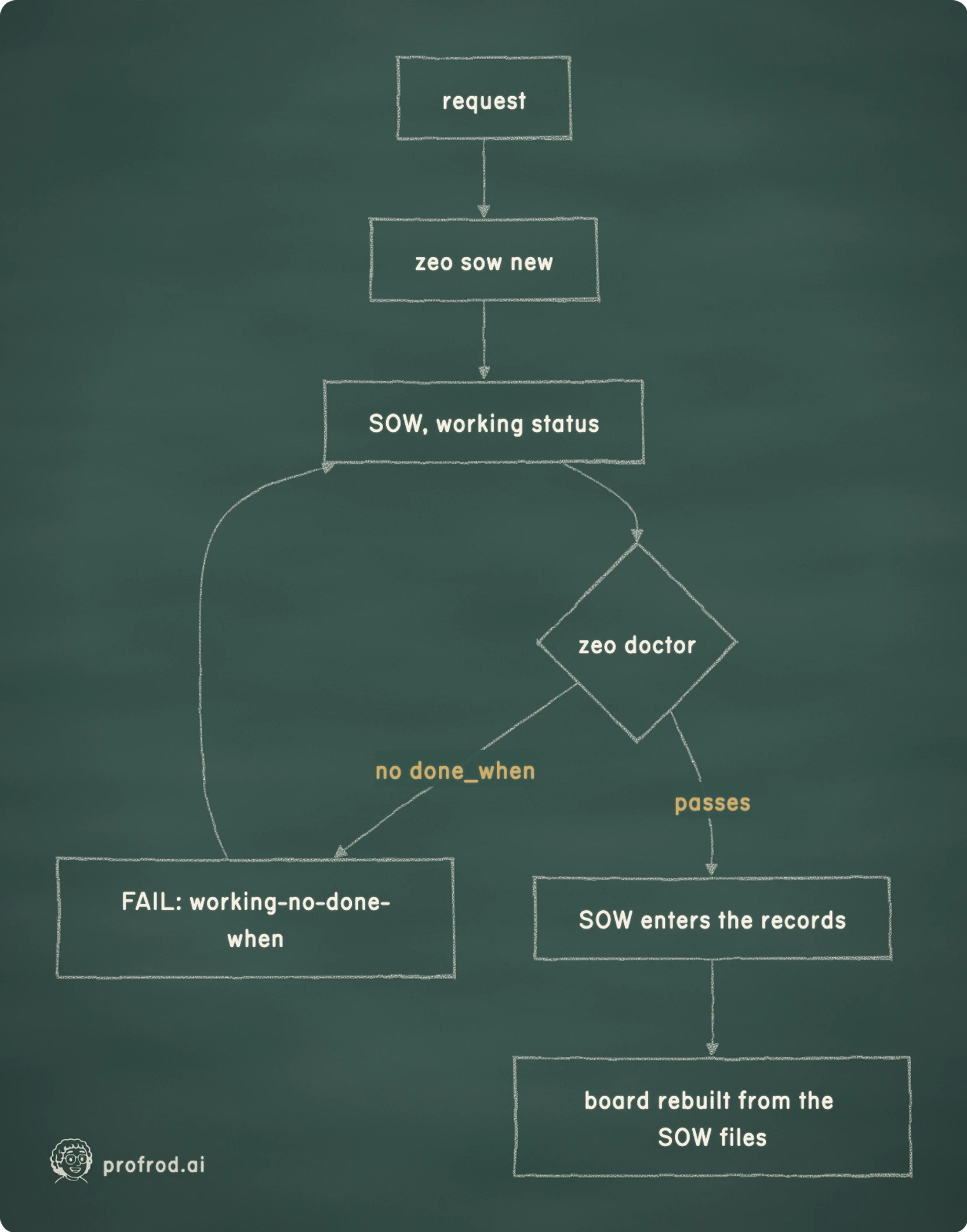
zeo sow new evals judge-audit --title "Audit the judge against hand labels" writes
projects/evals/sow/judge-audit/judge-audit-SOW-01-audit-the-judge-against-hand.md with
status: DESIGN and reports ✓ zeo lint passes.
DESIGN is a working status, so the file now breaks the rule.
zeo <path> prints ⚠ [working-no-done-when] working status requires done_when: as a warning and
still counts the file as 1 passed.
zeo doctor <path> reports the file as FAIL, with two errors: working-no-done-when and
authoring-schema (the effort field the tool calls restaufwand is missing too). It exits with
an error.
So the refusal lives in doctor, and the plain lint only warns. If you wire this into a gate, gate
on doctor.
The SOW that zeo sow new scaffolded carried done_when: Clear acceptance criteria established, and
lint passed. That sentence names no command and no result. The schema guarantees a stopping
condition exists; it cannot tell whether a reader could run it. That part is still a reviewer's
job, and it is the part people skip.
The board is a view, not a record
The same records answer the operator's daily question, "what is in flight?" A board command walks every SOW, keeps the latest revision of each stream and writes a summary file. The summary is rebuilt on every run and never edited by hand. If the summary and a SOW disagree, the SOW is right, because the summary is derived from it.
That design choice carries over directly to agent systems. An agent's own summary of what it did is a view. The record is the files, commits and logs it produced. When they disagree, trust the record, and build the summary from it rather than asking the agent to remember.
Why this matters in a lab
Every company building a software factory faces this control first: Cognition, Factory and the
coding-agent teams at every frontier lab ship agents whose reports of success have to be checked
against something they cannot edit. Put two agents in a research repository and give them a week. One runs a sweep; the other writes
up the results. Without a rule like done_when, "the sweep is done" means the agent stopped
talking about it. With the rule, it means a named command produced a named result: a results file
with one row per configuration, a seed recorded for each, and the evaluation run on the held-out
split.
An interviewer for a research-engineering or agents role could ask: you are running work through coding agents; how do you know a result they report is real? A strong answer names the stopping condition before the work starts, checks each claim where it is made rather than at the end, and keeps the record separate from the agent's summary of it. The research engineering course is built around exactly those habits.
What would prove this wrong
If agent claims of completion turned out to be reliable enough that per-claim checks cost more than the errors they catch, this discipline would be overhead. The arithmetic above says that is unlikely for long chains, but it is an empirical question for short ones: at two handoffs and p = 0.99, the chain is right 98% of the time, and a lighter touch may be rational. Measure your own p before deciding.
The book measures what delegation costs and how errors compound across subagents, on real models.