Draft chapter. The textbook guide covers setup and the supplied code. Practice in Exercise Book 13, then check Solutions 13 once you have tried it.
The supplier's order survived a lost response in Chapter 12. Now the process performing Lucy's work disappears. Its Python variables, open connection and current model conversation are gone. A replacement can reopen SQLite, but that alone does not tell it which assignment to continue or prevent the previous process from writing if it was merely delayed rather than dead.
Part A first measures how long a lease should be, and what a model does when it is asked to take over a crashed turn. Part B then constructs durable claims with expiring ownership and increasing generations. Every controlled write will check the claim against current records. The final experiment first kills an actual worker process, then repeats the scenario with an old worker that stays alive. Those are different failures. An implementation that only works when the old process has definitely stopped is insufficient for the second case.
The authority boundary from Chapter 12 remains in place. A replacement continues the existing approved operation and uses the same supplier identity. It does not ask a new model to reconstruct a purchase from a conversational summary. We will make that requirement observable by supplying a model object that fails if recovery tries to call it.
Learning objectives
Part A measures leases. After it you should be able to:
- explain why a crashed worker cannot be told apart from a slow one, and what a lease does instead;
- predict the false-expiry rate of a lease from the distribution of turn lengths;
- derive the detection delay of a crash, and explain the trade-off with false expiry;
- explain why a replacement must continue from records rather than ask a model what happened.
Part B builds recovery. After it you should be able to:
- separate a durable assignment from its executing process;
- claim eligible work atomically;
- explain leases and ownership generations;
- reject stale transcript, completion and supplier writes;
- recover an existing approved operation after a real process kill.
You will also distinguish process health, work progress, cancellation and external completion, rather than treating them as one green status.
The deliverable is a replacement worker that resumes eligible work while stale holders cannot make newly authorized writes through the controlled boundary. The checkpoint uses separate worker and HTTP supplier processes on a POSIX host. It observes actual lease expiry without rewriting the clock or ledger, and independently counts the supplier's orders.
Part A: slow or dead?
A replacement worker faces a question it cannot answer directly: has the previous worker died, or is it only slow? This part shows why the question has no certain answer, and how a lease turns it into two measurable errors. It then measures both errors on real model turns, and tests what a model does when it is asked to take over a crashed turn. The rest of the chapter builds on the answers.
The functions live in the chapter's learner file.
import json
import runpy

lease = runpy.run_path("book/textbook/learner/profrod_sovereign_agent_ch13_leases_learner.py")
measured = json.loads(open("docs/evidence/book-ch13/ch13-leases-receipt-v1.json").read())
Silence cannot say which
A worker that has said nothing for ten seconds may have crashed. It may also be waiting for a slow model call, paused by the operating system, or cut off from the database by a busy disk. In a system with no upper bound on how long a step can take, silence is consistent with all of these. This is the heart of a famous result by Fischer, Lynch and Paterson: in such an asynchronous system, no deterministic protocol can guarantee that processes reach agreement if even one of them may crash. The intuition is the one above: a crashed process cannot be told apart from a slow one.
Practical systems escape by adding time. A lease gives the holder the work for seconds. After that, another worker may take it, whether or not the first is dead. The lease does not answer the slow-or-dead question; it replaces it with a rule. The rule can err in two ways. A lease that is too short takes work away from a worker that is still working: a false expiry. A lease that is too long leaves a dead worker's work waiting: a detection delay.
False expiry is the latency tail
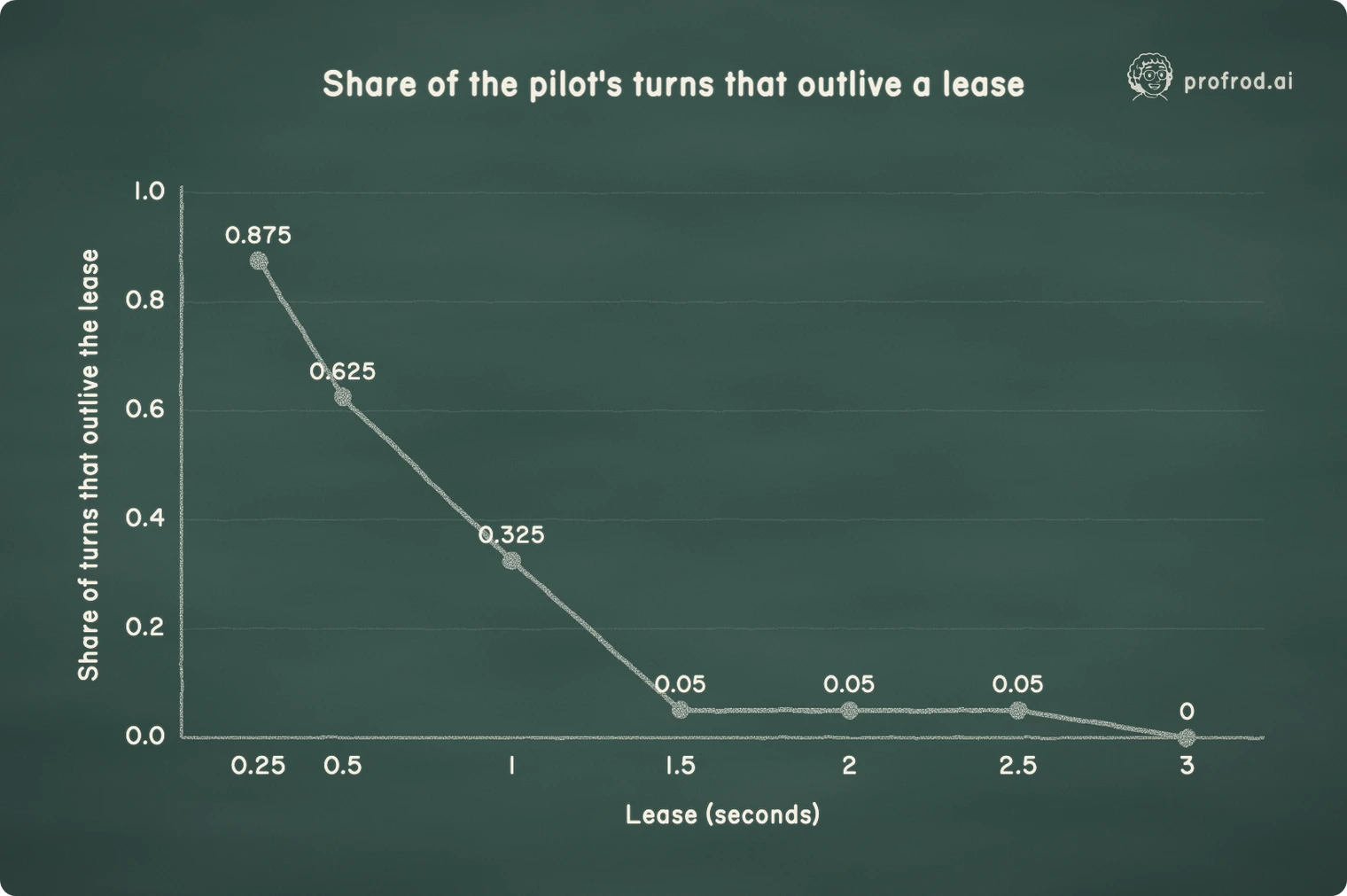
This book's runtime takes a lease at the start of a turn and does not renew it during the turn. A turn that takes longer than outlives its lease, so
$ P(\text{false expiry}) = P(\text{turn} > T). $
The lease must be chosen from the distribution of turn lengths, and the part that matters is the tail. The experiment measured 40 real turns: qwen2.5:0.5b answering eight kinds of shop task, with up to 256 generated tokens.
uv run python book/textbook/experiments/profrod_sovereign_agent_textbook_ch13_leases_v1.py \
--out ch13-leases-receipt.jsonpilot = measured["pilot_turn_seconds"]
for q in (50, 90, 100):
print(f"p{q} turn: {lease['percentile'](pilot, q)} s")
for target in (0.5, 0.1, 0.05, 0.0):
print(f"false expiry at most {target}: lease {lease['shortest_lease'](pilot, target)} s")p50 turn: 0.539 s
p90 turn: 1.334 s
p100 turn: 2.669 s
false expiry at most 0.5: lease 0.539 s
false expiry at most 0.1: lease 1.334 s
false expiry at most 0.05: lease 1.449 s
false expiry at most 0.0: lease 2.669 sHalf the turns finished within 0.54 seconds, but the tail is long: the 90th percentile is 1.33 seconds and the slowest turn took 2.67, five times the median. The cluster near 1.33 seconds is consistent with turns that reached the 256-token cap. Chapter 19's fitted step time, applied to this model's weights, puts 256 tokens at about 1.2 seconds, plus the prompt. The two slowest turns took about twice that. A lease short enough to feel responsive would take work away from live workers again and again.
The experiment then ran 20 new turns under each of three leases. A worker claimed the work, ran one turn and completed it with a fenced write: one that lands only if the worker's generation is still the current one. A replacement looked for expired work every 50 milliseconds and claimed it.
for row in measured["false_expiry"]:
    print(
        f"{row['rule']:23} lease {row['lease_seconds']} s: "
        f"predicted {row['predicted_false_expiry']}, measured {row['measured_false_expiry']}; "
        f"stale completions accepted "
        f"{row['stale_completions_accepted']}"
)pilot median lease 0.539 s: predicted 0.5, measured 0.45; stale completions accepted 0
pilot 90th percentile lease 1.334 s: predicted 0.1, measured 0; stale completions accepted 0
twice the pilot maximum lease 5.338 s: predicted 0.0, measured 0; stale completions accepted 0The median lease took work from a live worker in 9 of 20 turns, close to the predicted half. At the 90th percentile the prediction was 2 of 20, and none happened. With 20 trials, seeing none has probability , so this is not evidence against the prediction. In every takeover, the fence refused the old worker's completion when it finally arrived, so a late result could not overwrite the replacement's claim. The false expiries cost repeated work, not correctness.
Detection delay is the lease
Now suppose the worker really crashes. Its lease started with its turn, so a crash at time into a turn is noticed when the lease runs out, later, plus the wait until the replacement next looks. If crashes fall uniformly within a turn of length , and the replacement looks every seconds,
$ E[\text{delay}] = T - \frac{D}{2} + \frac{s}{2}. $
The experiment stopped a worker at a random moment within a typical turn, 20 times, under the safe lease of twice the pilot maximum.
crash = measured["detection"]
print("lease", crash["lease_seconds"], "s; typical turn", crash["turn_seconds"], "s")
print("predicted mean delay", crash["predicted_mean_delay"], "s")
print("measured mean delay", crash["measured_mean_delay"], "s")lease 5.338 s; typical turn 0.539 s
predicted mean delay 5.094 s
measured mean delay 5.115 sThe measured delay, 5.12 seconds, is within 0.03 seconds of the prediction, and nearly all of it is the lease itself. The lease that made false expiry vanish also makes every crash wait about five seconds before anyone notices: ten times the typical turn.
xychart-beta
    title "Share of the pilot's turns that outlive a lease"
    x-axis "Lease (seconds)" [0.25, 0.5, 1, 1.5, 2, 2.5, 3]
    y-axis "Share of turns that outlive the lease" 0 --> 1
    line [0.875, 0.625, 0.325, 0.05, 0.05, 0.05, 0]
A replacement must not ask the model what happened
The replacement now holds the work. The tempting way to continue is to hand the old conversation to a model and say "carry on". The experiment tried exactly that. A worker had called place_order for Lucy's six tubs and stopped before the supplier's reply was recorded. Each of two models received that transcript, a lookup_order tool, and the message that it was the replacement and should continue the task, 20 times.
for row in measured["recovery"]:
    print(
        f"{row['model']}: placed the order again {row['placed_again']}/{row['samples']}, "
        f"looked it up {row['looked_up']}/{row['samples']}"
)qwen2.5:0.5b: placed the order again 14/20, looked it up 0/20
qwen2.5:1.5b: placed the order again 1/20, looked it up 1/20qwen2.5:0.5b placed the order again in 14 of 20 samples and never looked it up. If the first order was accepted, each of those is a second order for Lucy: exactly the uncertain case of Chapter 12. qwen2.5:1.5b called a tool in only 2 of 20 samples, once to order again and once to look the order up. Most of its replies asked Lucy for the supplier's response, and some said in text that they would place the order again.
Neither behavior is a recovery procedure. The records already say what to do. An approved operation with a stable key exists and its outcome is uncertain, so the replacement must look it up by that key before anything else.
The decision
Three rules follow, and Part B implements each:
- Choose the lease from the measured tail, with margin. A bound on the turn, such as a token cap, makes the tail predictable. Measurement still decides, because the pilot's two slowest turns took about twice as long as the cap alone implies.
- Fence every write, because false expiry will sometimes happen. A lease without a fence is only a hope that the old worker has stopped.
- Recover from records, not from the model. The approved operation and its key are already durable. A replacement that continues them cannot place a second order, whatever a model would have done.
Part B: recover work after a process crash
Part A measured the lease and showed why the replacement must not improvise. This part builds the claim, the fence and the recovery path, and tests them with a worker process that is really killed and one that is really still alive.
An assignment outlives the process that holds it
Chapter 8's work row already holds the assignment: its source, session and text. Chapter 11 added a lease row that says who holds it and until when. This chapter adds a generation to that lease, which says which acquisition is current. A process may hold one assignment, disappear and be replaced, while the assignment identity remains unchanged. The model provider is another replaceable component used during that execution.
An operating-system process identifier is useful evidence during the failure experiment. It is not the work identity and is not a permanent authority credential. Process identifiers can be reused; a long-lived process can perform many assignments. Our runtime typically gives each execution a fresh owner identifier and always checks it together with the work's generation and current state.
| Identity or state | Example | What it describes |
|---|---|---|
| Work ID | One durable morning assignment | The task being carried forward |
| Owner | A fresh execution identifier | The current holder's label |
| Generation | One, then two after replacement | Which acquisition is current |
| Lease expiration | An absolute epoch timestamp | How long this holding remains eligible |
| Process ID | The child observed by the experiment | The operating-system process |
| Supplier operation | The existing exact order identity | The intended external effect |
Scroll horizontally to view columns.
The Claim object carries the values a worker must present later. Its worker_id, the owner label joined to the generation, is the identity Chapter 8's work row and Chapter 11's checks already compare, so those checks become a generation fence without changing them. It is frozen to discourage accidental local mutation, but a Python dataclass is not a security boundary. Trusted runtime code constructs and checks it. The model never receives a tool for manufacturing arbitrary claims, and the next chapter will constrain untrusted executable tools outside the host process.
import json
import math
import runpy
import tempfile
import time
from dataclasses import dataclass
from pathlib import Path
from typing import Any

APPROVAL = runpy.run_path("book/textbook/learner/profrod_sovereign_agent_ch11_approval_learner.py")
execute = APPROVAL["execute"]


LEASE_MIGRATIONS = {
    1: (
        "ALTER TABLE assignment_leases ADD COLUMN generation INTEGER NOT NULL DEFAULT 1",
        "CREATE TABLE transcript ("
        " seq INTEGER PRIMARY KEY AUTOINCREMENT, work_id INTEGER NOT NULL,"
        " generation INTEGER NOT NULL, message TEXT NOT NULL)",
        "CREATE TABLE outcomes ("
        " work_id INTEGER PRIMARY KEY, generation INTEGER NOT NULL,"
        " status TEXT NOT NULL CHECK (status IN ('DONE', 'BLOCKED', 'CANCELED')),"
        " result TEXT NOT NULL)",
    ),
}


def open_worker_shop(path):
    """Chapter 11's shop and queue, with leases that carry a generation."""
    db, queue = APPROVAL["open_shop"](path)
    db.migrate("leases", LEASE_MIGRATIONS)
    return db, queue


@dataclass(frozen=True)
class Claim:
    """What a worker must present to write: which work, which acquisition, and until when."""

    work_id: int
    session_id: str
    text: str
    owner: str
    generation: int
    expires: float

    @property
    def worker_id(self) -> str:
        # The identity Chapters 8 and 11 check: an owner label plus the acquisition it made.
        return f"{self.owner}#{self.generation}"


def enqueue(queue, source_id: str, session_id: str, text: str) -> int:
    """Admit work through Chapter 8's queue and return its id."""
    if queue.admit(source_id, session_id, text) not in {"accepted", "duplicate"}:
        raise ValueError("work was not admitted")
    return queue.store.connection.execute(
        "SELECT work_id FROM work WHERE source_id=?", (source_id,)
    ).fetchone()[0]


temporary = tempfile.TemporaryDirectory(prefix="lucy-ch13-")
location = Path(temporary.name) / "agent.sqlite"
db, queue = open_worker_shop(location)
first_id = enqueue(queue, "phone:first", "lucy", "Prepare the stock draft")
second_id = enqueue(queue, "phone:second", "lucy", "Explain the draft")
print("Distinct assignments:", first_id != second_id)
print(
    "Queued work:",
    db.connection.execute("SELECT count(*) FROM work WHERE state='pending'").fetchone()[0],
)Distinct assignments: True
Queued work: 2The second turn must not start while the first has a live holder, because both use the same session context and can affect related business records. Different sessions may proceed independently within their own limits. Serializing a session is a useful local policy; it does not by itself authorize a supplier request or protect a global spending ceiling. Those checks still belong to their own transaction boundaries.
Claim work in one transaction
A worker must not read an eligible row, release the database lock and only later mark itself as owner. Another process could make the same choice in between. The claim transaction acquires SQLite's write lock before selecting work, checks eligibility, increments the generation, records the new holder and lease, and returns the resulting claim.
Eligible means pending, or running with an expired lease. The query also refuses a session that already has another unexpired running item, and takes the oldest work first. The finished agent adds priorities for operator commands and recovery-only passes; its ownership mechanism is the same.
def claim(db, owner: str, *, ttl: float = 90, now: float | None = None) -> Claim | None:
    """Acquire the oldest work that is pending, or running under an expired lease, in one
    transaction. A session with another live holder is skipped, so its turns stay in order."""
    now = time.time() if now is None else now
    if not owner or "#" in owner or not math.isfinite(ttl) or not 0 < ttl <= 3600:
        raise ValueError("an owner label and a bounded lease are required")
    with db.immediate() as connection:
        row = connection.execute(
            "SELECT w.work_id, w.session_id, w.text, w.state, coalesce(l.generation, 0)"
            " FROM work w LEFT JOIN assignment_leases l ON l.work_id = w.work_id"
            " WHERE (w.state = 'pending' OR (w.state = 'running' AND l.expires <= ?))"
            " AND NOT EXISTS (SELECT 1 FROM work other"
            "   JOIN assignment_leases ol ON ol.work_id = other.work_id"
            "   WHERE other.session_id = w.session_id AND other.state = 'running'"
            "   AND ol.expires > ?)"
            " ORDER BY w.work_id LIMIT 1",
            (now, now),
        ).fetchone()
        if row is None:
            return None
        work_id, session_id, text, state, previous = row
        held = Claim(work_id, session_id, text, owner, previous + 1, now + ttl)
        if state == "pending":
            connection.execute(
                "UPDATE work SET state = 'running', worker_id = ? WHERE work_id = ?",
                (held.worker_id, work_id),
            )
        else:
            connection.execute(
                "UPDATE work SET worker_id = ? WHERE work_id = ?", (held.worker_id, work_id)
            )
        connection.execute(
            "INSERT INTO assignment_leases (work_id, worker_id, expires, generation)"
            " VALUES (?, ?, ?, ?) ON CONFLICT (work_id) DO UPDATE SET"
            " worker_id = excluded.worker_id, expires = excluded.expires,"
            " generation = excluded.generation",
            (work_id, held.worker_id, held.expires, held.generation),
        )
    return held


first = claim(db, "old-owner", ttl=30)
other_connection, _ = open_worker_shop(location)
print("First assignment held:", first.work_id == first_id)
print("Generation:", first.generation)
print("Competing claim:", claim(other_connection, "new-owner"))First assignment held: True
Generation: 1
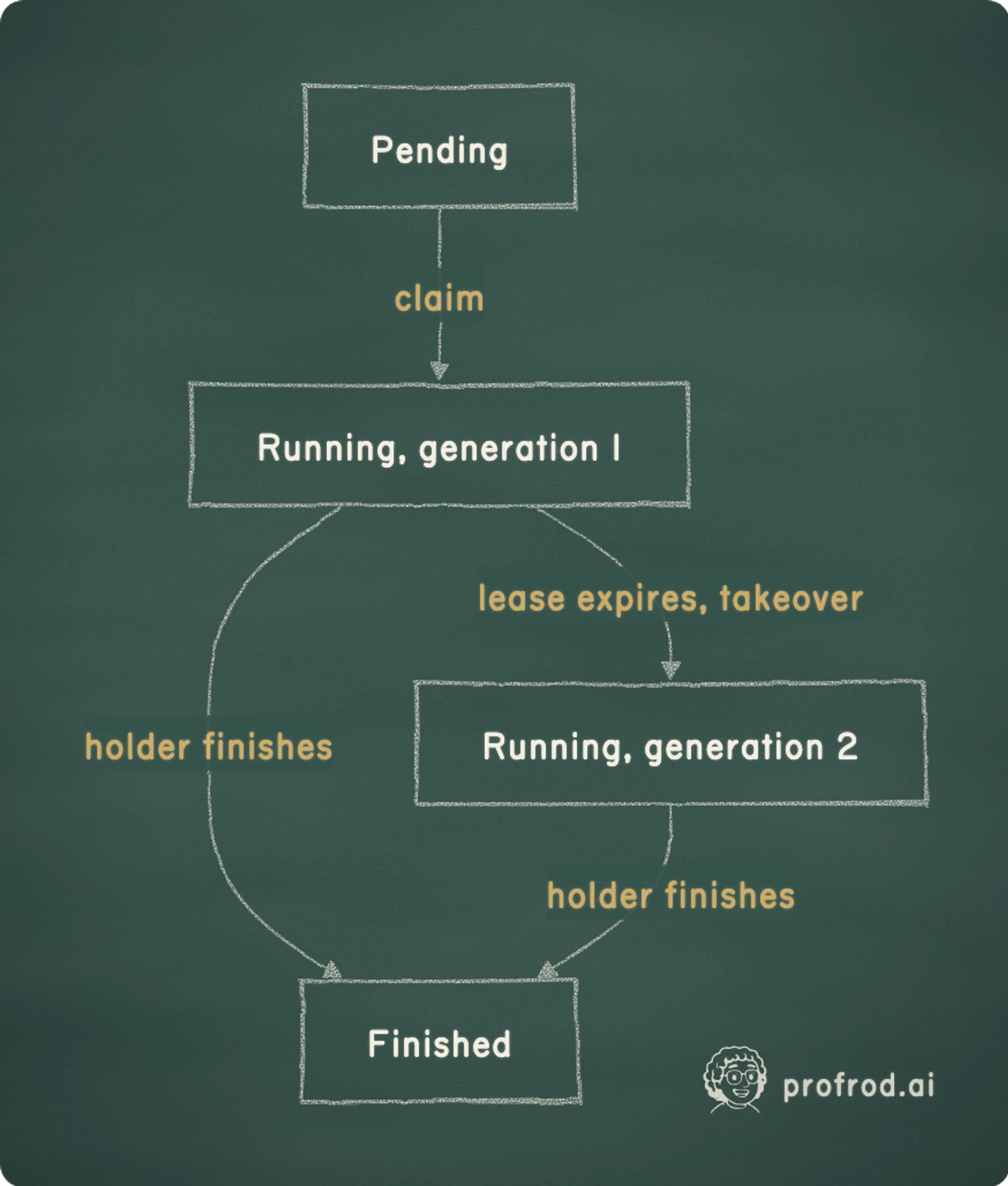
Competing claim: NoneThe query is longer than a simple queue pop because it says three things at once: which states are eligible, that an expired lease may be taken over, and that a session with a live holder waits. A pending row moves to running, and a running row keeps its state while its holder changes.
flowchart LR
    P[Pending] -->|claim| G1[Running, generation 1]
    G1 -->|lease expires, takeover| G2[Running, generation 2]
    G1 -->|holder finishes| F[Finished]
    G2 -->|holder finishes| F
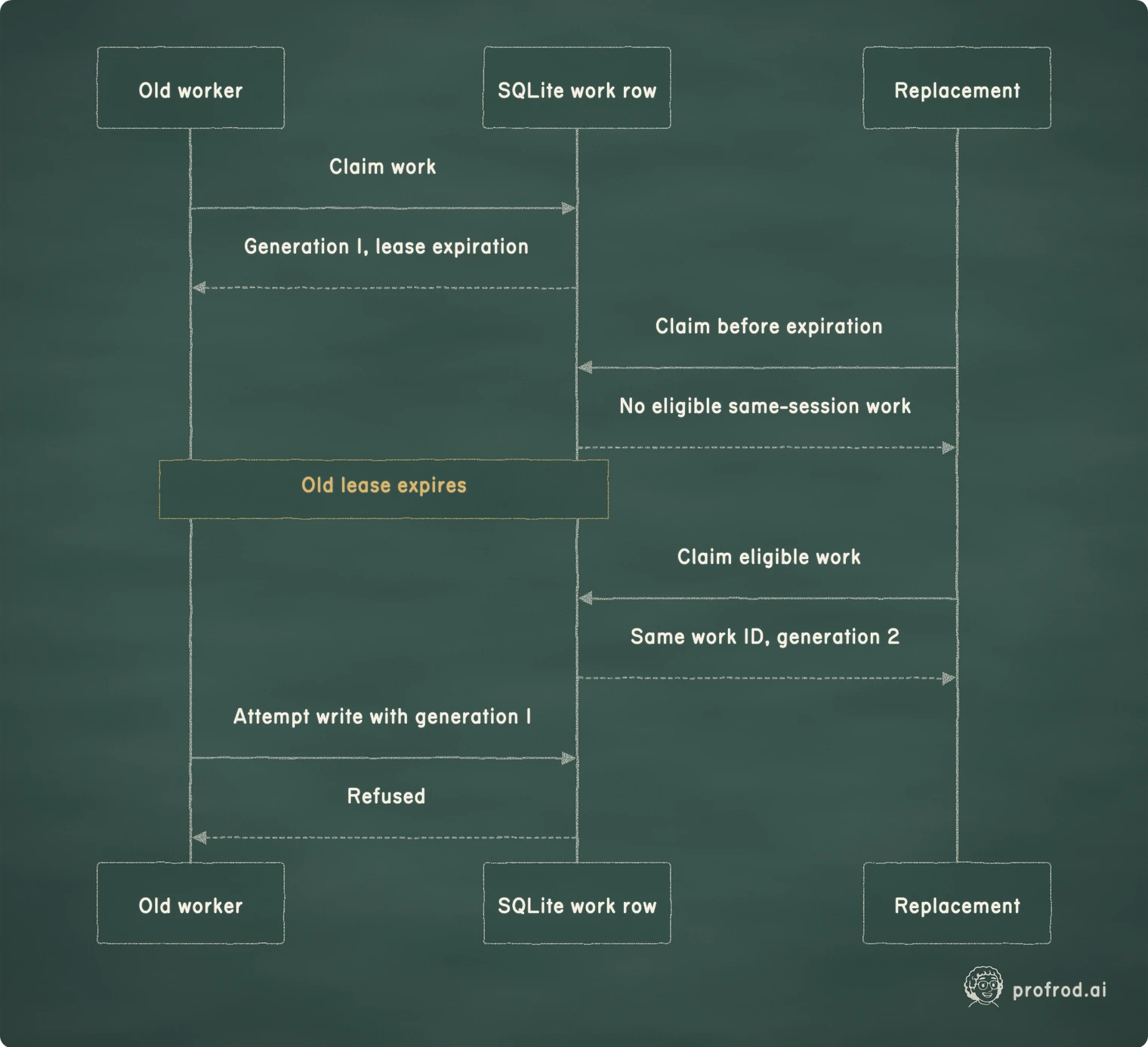
The generation increases even if the owner label is reused. That is important: an old process might resume with the same configured name as its replacement. Checking only the label would let both look current. A claim for generation one cannot authorize writes after the row advances to generation two, even when both callers describe themselves as Lucy's stock worker.
sequenceDiagram
    participant A as Old worker
    participant DB as SQLite work row
    participant B as Replacement
    A->>DB: Claim work
    DB-->>A: Generation 1, lease expiration
    B->>DB: Claim before expiration
    DB-->>B: No eligible same-session work
    Note over A,DB: Old lease expires
    B->>DB: Claim eligible work
    DB-->>B: Same work ID, generation 2
    A->>DB: Attempt write with generation 1
    DB-->>A: Refused
Expiry is permission to replace, not proof of death
A lease gives the holder a bounded opportunity to act. Its expiration does not prove that the process died. The process may be paused, overloaded or waiting on a dependency. We therefore design replacement so that the old process can remain alive without retaining authority to commit new results. The final experiment deliberately keeps it alive to test this distinction.
Persistent leases use wall-clock epoch timestamps so another process can interpret them after restart. The model loop uses a monotonic clock for its local elapsed-time budget. Those clocks serve different purposes. A forward wall-clock jump may make a holder eligible for early replacement; a backward jump may delay recovery. Generation checks still distinguish holders, but this teaching deployment does not claim tolerance of arbitrary clock faults or distributed clock disagreement.
The runtime keeps turns bounded instead of building a general lease-renewal system. Its claim lifetime is the configured loop duration plus a margin, and the supplier admission check refuses a request whose declared wait would exceed the remaining lease. A tool handler must also honor its timeout contract. An unbounded Python function running inside the process is not made cancellable by merely storing an expiration timestamp.
For the inline example, inject a later observation time into the claim function. This exercises the transition without sleeping for thirty seconds. The separate process checkpoint later uses a short real lease and waits for actual expiry. Keeping those forms of evidence distinct makes the chapter reproducible without calling simulated time an operational test.
replacement = claim(other_connection, "new-owner", now=first.expires, ttl=30)
print("Same durable work:", replacement.work_id == first.work_id)
print("New generation:", replacement.generation)
print("New owner:", replacement.owner)
print(
    "Second assignment still queued:",
    db.connection.execute("SELECT state FROM work WHERE work_id=?", (second_id,)).fetchone()[0],
)Same durable work: True
New generation: 2
New owner: new-owner
Second assignment still queued: pendingThe database state is now authoritative about the current holder. An old stack frame can still contain the original Claim, and an old conversation can still describe the task correctly. Neither fact changes the generation in SQLite. Recovery depends on that durable distinction rather than trying to inspect every process's memory and decide which one has the most convincing account.
Fence every controlled write with current ownership
Acquisition alone is insufficient. A worker can pass its initial check and then lose the lease while waiting for a model response. The runtime must recheck ownership when it appends a transcript observation, declares the assignment complete, reserves another model call or admits a supplier request. A check only at the start of the loop leaves later writes exposed to stale results.
The current-holder check compares the work's state, the worker identity, which carries the owner and generation, the lease's generation and its expiry. Chapter 19 adds one more comparison, for a database restored from a backup. For process replacement, the generation is what changes.
def assert_current(connection, held: Claim, now: float | None = None) -> float:
    """Refuse unless this acquisition is still the current, unexpired holder; return expiry."""
    now = time.time() if now is None else now
    row = connection.execute(
        "SELECT w.state, w.worker_id, l.generation, l.expires FROM work w"
        " JOIN assignment_leases l ON l.work_id = w.work_id WHERE w.work_id = ?",
        (held.work_id,),
    ).fetchone()
    if (
        row is None
        or row[0] != "running"
        or row[1] != held.worker_id
        or row[2] != held.generation
        or row[3] <= now
    ):
        raise PermissionError("worker claim expired or superseded")
    return row[3]


try:
    assert_current(db.connection, first)
except PermissionError:
    print("Old holder refused")
assert_current(other_connection.connection, replacement)
print("Replacement accepted")Old holder refused
Replacement acceptedThe check reads the work row and the lease in the same transaction as the write it guards, so no other holder can acquire the work between the check and the write. These checks operate within trusted application code and the controlled database boundary; they are not proof that arbitrary host code cannot edit files directly.
Chapter 18 adds a narrower contract for delegated work, a live deadline and an uncancelled parent, checked in the same way.
Reject stale observations and stale completion
A fluent model response can arrive after its holder was replaced. Persisting it under the new generation would falsely attribute old work to the replacement. The observation function therefore takes the held claim and validates it inside the transaction that appends the transcript row. The row records the actual generation that produced the observation.
Completion follows the same pattern. Only the current holder can finish the assignment and record its outcome, DONE, BLOCKED or CANCELED, with its result. The terminal label describes the work result; it is not an operating-system exit code. A process can exit cleanly after recording blocked work, or crash after durable work has already completed.
Finishing is terminal here: a blocked item does not return to the queue on its own. That keeps a missing permission from becoming a loop that repeatedly asks the model for a way around it.
def observe(db, held: Claim, message: dict[str, Any]) -> None:
    """Append one transcript message, attributed to the generation that produced it."""
    with db.immediate() as connection:
        assert_current(connection, held)
        connection.execute(
            "INSERT INTO transcript (work_id, generation, message) VALUES (?, ?, ?)",
            (held.work_id, held.generation, json.dumps(message, allow_nan=False)),
        )


def finish(db, held: Claim, status: str, result: str) -> None:
    """Only the current holder may end the work and record its outcome."""
    if status not in {"DONE", "BLOCKED", "CANCELED"}:
        raise ValueError("invalid terminal work state")
    with db.immediate() as connection:
        assert_current(connection, held)
        connection.execute("UPDATE work SET state = 'finished' WHERE work_id = ?", (held.work_id,))
        connection.execute(
            "INSERT INTO outcomes (work_id, generation, status, result) VALUES (?, ?, ?, ?)",
            (held.work_id, held.generation, status, result),
        )


for name, action in {
    "transcript": lambda: observe(db, first, {"role": "assistant", "content": "old answer"}),
    "completion": lambda: finish(db, first, "DONE", "old result"),
}.items():
    try:
        action()
    except PermissionError:
        print(name, "refused")
observe(other_connection, replacement, {"role": "assistant", "content": "current observation"})
finish(other_connection, replacement, "DONE", "current result")
print(
    "Stored result:",
    db.connection.execute("SELECT result FROM outcomes WHERE work_id=?", (first_id,)).fetchone()[0],
)
print("Transcript rows:", db.connection.execute("SELECT count(*) FROM transcript").fetchone()[0])transcript refused
completion refused
Stored result: current result
Transcript rows: 1The assertions check the resulting data, not just the presence of a guard function. The stale transcript never becomes a row, the stale completion never becomes the work result, and the replacement's single observation is retained. If the check and write used separate transactions, another holder could acquire the task between them; keeping them together closes that local race.
The second turn in Lucy's session can now become eligible because the first no longer has a live running holder. It receives its own work identity and generation. This prevents conversation serialization from becoming a permanent lock after a task completes, while still allowing unfinished work to preserve its place through a process failure.
next_turn = claim(db, "next-owner")
print("Next assignment:", next_turn.work_id == second_id)
print("Its first generation:", next_turn.generation)
finish(db, next_turn, "DONE", "The prior draft is recorded.")
print(
    "Work outcomes:",
    [row[0] for row in db.connection.execute("SELECT status FROM outcomes ORDER BY work_id")],
)
db.close()
other_connection.close()
temporary.cleanup()Next assignment: True
Its first generation: 1
Work outcomes: ['DONE', 'DONE']Connect the checks to the owned loop
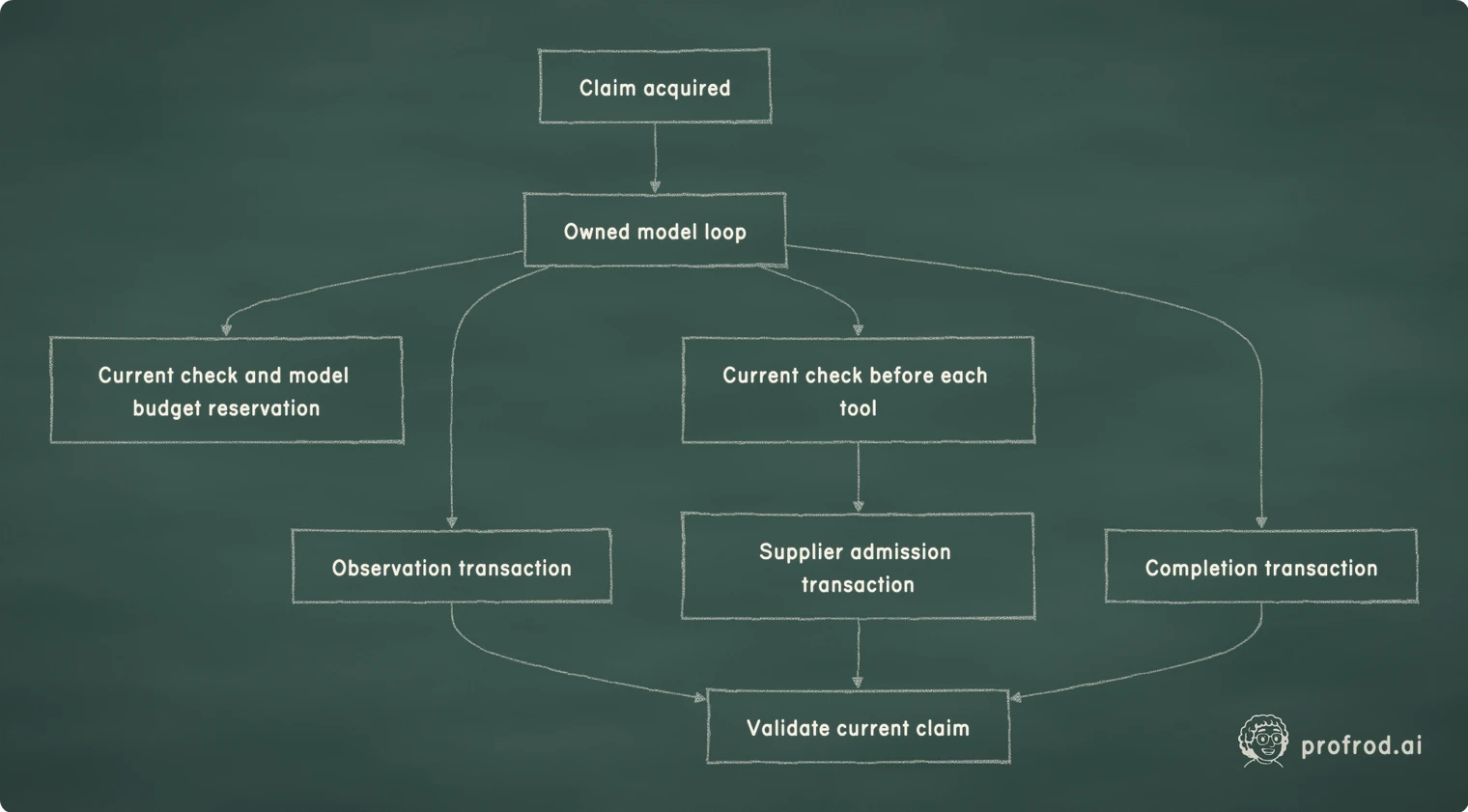
A turn that calls the model needs these checks around every step: before another model call, before each tool call, and when a returned message becomes durable. The finished agent passes them to its loop as callbacks: an observation writer, a current-holder check and a model-call reservation. The supplier path has its own admission transaction, Chapter 11's execute, because a loop-level check alone cannot cover a later external effect. The recovery turn in the next section needs none of the loop, because it calls no model.
Those callbacks carry the same held work record into the database operations. The model never updates its own generation, and a replacement does not edit the old process's local object. A stale response may still exist in memory, but an attempted observation or controlled write fails against the current row. That is the data-flow connection that makes the fencing mechanism useful rather than merely present in a helper module.
flowchart LR
    C[Claim acquired] --> L[Owned model loop]
    L --> M[Current check and model budget reservation]
    L --> T[Current check before each tool]
    L --> O[Observation transaction]
    O --> V[Validate current claim]
    T --> S[Supplier admission transaction]
    S --> V
    L --> F[Completion transaction]
    F --> V
Cancellation deliberately invalidates running authority and revokes eligible unsent orders. It may leave an uncertain supplier outcome requiring recovery. A recovery-only pass can discover that outcome without treating cancellation as new permission to transmit. The useful question is always which action is being authorized now: writing a result, sending a purchase and discovering an existing receipt are different actions.
Recover from records before asking the model again
A replacement should start by inspecting the assignment and its operational records. If an exact order is already approved, it can continue the controlled order path. If an order is uncertain, it discovers that existing operation before any possible retransmission. A summary can provide context, but it is not the source of truth for whether money was reserved or a supplier accepted a purchase.
The recovery turn makes this ordering structural: recover_once takes no model at all. It claims the work, finds its approved or uncertain orders, and continues each one through Chapter 11's execute, which checks every authority again before sending. Anything else is finished as blocked, for a turn that may call the model. The experiment can pass only if the durable approval and operation identity are enough to complete the work.
def recover_once(db, *, owner: str, supplier, policy, ttl: float = 30) -> dict[str, Any]:
    """Take over expired or waiting work and continue only what is already recorded.

    This turn has no model. If the work holds an approved or uncertain order, it continues that
    exact order through Chapter 11's send check. Anything else needs a new turn with a model,
    and is left blocked rather than guessed at.
    """
    held = claim(db, owner, ttl=ttl)
    if held is None:
        return {"status": "IDLE"}
    orders = [
        row[0]
        for row in db.connection.execute(
            "SELECT id FROM assistant_orders WHERE work_id = ?"
            " AND status IN ('APPROVED', 'SENDING', 'UNKNOWN') ORDER BY created, id",
            (held.work_id,),
        )
    ]
    if not orders:
        finish(db, held, "BLOCKED", "No recorded approval to continue; a new turn is needed.")
        return {"status": "BLOCKED", "work": held.work_id, "generation": held.generation}
    receipts = [execute(db, held, order, supplier, policy=policy) for order in orders]
    if all(receipt.get("status") in {"ACCEPTED", "REJECTED"} for receipt in receipts):
        pairs = zip(orders, receipts, strict=True)
        summary = ", ".join(f"{order}: {receipt['status']}" for order, receipt in pairs)
        finish(db, held, "DONE", "Continued the approved orders. " + summary)
        return {"status": "DONE", "work": held.work_id, "generation": held.generation}
    finish(db, held, "BLOCKED", "An order's outcome is uncertain; discover it before retrying.")
    return {"status": "BLOCKED", "work": held.work_id, "generation": held.generation}
This does not mean every interrupted task can resume without another model call. A read-only research turn might need to rebuild bounded context and continue reasoning. Its new call must still reserve budget and pass ownership checks. The claim in this chapter is narrower: already-recorded business effects and approvals must not be reconstructed from model recollection when authoritative records exist.
Failure experiments: a killed holder and a live stale holder
Run the checkpoint from the course folder:
uv run python book/textbook/checkpoints/profrod_sovereign_agent_ch13_worker_recovery_checkpoint.py
uv run python book/textbook/checkpoints/profrod_sovereign_agent_ch13_worker_recovery_checkpoint.py --evidence
Each case starts a separate HTTP supplier and fresh shop database. The parent enqueues one vanilla assignment. An actual child process claims it with a short lease, persists the six-tub proposal and operator approval, writes a ready record and waits. The parent checks that a competing claim cannot proceed while that lease is still current.
In the first case the parent sends SIGKILL to the child and verifies the operating-system exit status. It waits for the actual lease expiration, then runs recover_once as the replacement. The replacement acquires generation two, sends the existing approved operation and finishes the work. The remote supplier database must contain one order with that original operation identity.
In the second case the child remains alive. After real expiry, the replacement completes the same sequence. Only then does the parent release the old child. The child attempts to append an observation, declare completion and execute the supplier operation using its old claim. All three must raise PermissionError. The remote count remains one and the stale transcript contributes no rows.
| Case | Old worker | Replacement | Supplier orders | Old worker's later writes |
|---|---|---|---|---|
| Killed | Exits with SIGKILL holding generation 1 | Claims generation 2 after the lease expires; sends the approved order | 1 | None: the process is gone |
| Still alive | Paused, holding generation 1 | Claims generation 2 after the lease expires; sends the approved order | 1 | Transcript, completion and supplier send: all three refused |
Scroll horizontally to view columns.
The experiment's ready record is written through a temporary file and renamed, so the parent does not mistake a partially written JSON file for a completed setup. Every wait is bounded. Cleanup terminates any remaining child and supplier processes, including on assertion failures. These details belong in a failure experiment because a test that leaves workers behind can contaminate the next run and produce misleading evidence.
The stale case's writes come after the replacement has finished, so a finished row alone would refuse them. The checkpoint therefore also tests the fence while the replacement still holds the work: the same owner label reacquires expired work as generation 2, its generation-1 claim is refused for a transcript write and for completion, and a second turn in the same session waits. Removing the identity check, freezing the generation, unfencing completion or unserializing sessions each fails that test. The evidence file records the killed child's negative signal status, generation two in both cases, one supplier order per case and three refused stale boundaries in the live-old case. It does not label a simulated exception as a hard kill or a rewritten expiration as elapsed wall time.
A crash after remote acceptance is a separate position
The checkpoint kills its worker before the first supplier transmission. The finished agent in the sovereign-agent repository also has an actual agent serve test that waits until the supplier has committed an order, then kills the agent before its local receipt is recorded. That case combines this chapter's replacement ownership with Chapter 12's ambiguous effect. The replacement must reconcile the original operation before processing unrelated later work.
That service test accelerates lease and backoff expiry by explicitly changing the fixture after the old process is killed. It does not claim to have waited through the production lease. Its distinct purpose is to inspect recovery ordering at the remote-commit boundary, including the retained reservation and one independent supplier order. The two experiments complement one another without being described as identical proofs.
| Failure position | Durable facts available | Required continuation |
|---|---|---|
| Before work admission commits | No admitted work record | Intake can present the origin again |
| After approval, before sending | Exact proposal and reservation | Current replacement can continue that operation |
| After supplier acceptance, before local receipt | Intent and uncertain local outcome | Discover the existing operation first |
| After local completion commits | Terminal work and receipt | Reuse the result; do not repeat the purchase |
Scroll horizontally to view columns.
The stale-holder fence governs admission to new controlled writes. It cannot recall a request that the old holder already transmitted while authorized. A supplier may finish that request after the lease expires. Stable operation identities and reconciliation handle that external boundary; ownership generations handle which local execution is currently allowed to act. Removing either mechanism leaves a different class of failure exposed.
Compare writer authority at a delivery boundary
OpenClaw's session-writer-delivery-authority.ts, pinned to commit 354538083db0a8728e16238cbd0b7a304416ff24 and inspected on 7 September 2026, contains checks for current session identity and optional lifecycle revision and writer-run identity. For a reply carrying that authority metadata, changed ownership can prevent final delivery. The source has a separate permitted path when no such metadata is attached. See the pinned implementation.
The code comments document revalidation against the latest committed writer. Our interpretation is that it addresses the same broad danger of a delayed result crossing a boundary after ownership changes. We compare that particular reply-delivery check with our transcript, completion and supplier checks; we do not claim equivalent system-wide coverage or that fencing is unique to this book. A useful experiment would attach an old writer identity to a delayed result and change the current writer before delivery.
In a coding agent
A resumed Claude Code session continues from records. Resuming restores the conversation history, the model and unexpired scheduled tasks. It does not restore bypassed permissions: a session resumed from bypassPermissions returns to the mode a new session would start in. Background Bash tasks do not come back.
This chapter's replacement worker had the same rule and a stronger one: it continued from records without asking the model to reconstruct what happened, because one model re-placed a crashed order in 14 of 20 samples. For parallel work, worktrees give each session its own checkout. While a session is isolated in one, Claude Code blocks edits and commands aimed at the main checkout, a fence around what each worker may touch.
Try it in Claude Code: start two sessions with claude --worktree a and claude --worktree b, and ask one to edit a file in the other's checkout.
Expected observations and learner verification
The process checkpoint reports DONE for the replaced killed worker, three refused boundaries for the live stale worker, one supplier order in each isolated case and zero new model calls during recovery. Inspect the evidence output to distinguish the SIGKILL case from the cleanly exiting stale child. The supplier count comes from its separate SQLite database, not from the agent's own claim that it succeeded.
make test runs this checkpoint with the supplied package blocked, because every function it calls is yours. A passing run establishes the named single-host behaviors; it is not a test of SQLite on a network filesystem, arbitrary remote tools or multi-host clock coordination.
Use the service observations from Chapter 10 to distinguish host availability from work recovery. Restart=on-failure can start a new process, but only the runtime's durable records and checks make that process a safe replacement. Conversely, sound recovery logic is unavailable while the host or its storage is down. An operational report should expose both service health and outstanding work, not replace either with a single success icon.
Exercise 1: Reuse the owner label
Acquire and replace a claim using the same owner string in both acquisitions. Keep the old claim object and try to complete work with it. Require refusal because its generation is stale. Explain why logging only the owner label would make the two executions hard to distinguish even though the database correctly rejects one of them.
Exercise 2: Cancel while a result is delayed
Hold a claimed turn before its completion callback, cancel the assignment through the controlled operator path and then release the result. Require the stale completion to be refused. Repeat with a supplier request that was already accepted and distinguish discovery of its receipt from authority to place another order. Keep the uncertain reservation until its outcome is known.
Exercise 3: Remove one fence from a copy
In a disposable copy of the observation function, omit the current-holder check while leaving completion protected. Release a stale model response and inspect the transcript. The experiment should reveal that a protected final status does not prevent incorrectly attributed observations. Restore the check and verify that the stale row is absent, not merely accompanied by a later warning.
Exercise 4: Separate sessions from account spending
Queue work in two different sessions and allow both to claim independently. Give each a proposed order that individually fits policy but whose combined reservations exceed the account ceiling. Verify that session concurrency is permitted while only the affordable reservation is admitted. Explain why a per-session lock cannot replace the account-level transaction from Chapter 11.
Exercise 5: Renew the lease, and measure what it costs
Change the experiment so the worker renews its lease halfway through each turn, from a second thread, and set the lease to the pilot median. Measure false expiry and detection delay again. Renewal lets a short lease survive a long turn. What new failure appears if the renewing thread keeps running after the turn itself has hung?
Exercise 6: Give the replacement the records
Rerun the recovery measurement, but add the durable record to the replacement's message: the operation key, its status UNKNOWN and the rule that an unknown operation must be looked up first. Count re-orders and lookups for both models. Then explain why the checkpoint's replacement makes no model call at all, and when a model call during recovery would still be appropriate.
Active recall
Without rereading: why can a replacement not tell whether the previous worker died? Predict the false-expiry rate of a lease set at the median turn length. What does the detection delay consist of? What did the replacement models do with the crashed transcript?
What survives a process kill? Why is an expired lease not evidence that its process died? Which value distinguishes two acquisitions with the same owner label? Why must ownership be checked inside an observation transaction? When may a replacement continue without a model call? What must still be reconciled if an old authorized request completes after replacement?
Vocabulary
An asynchronous system has no bound on how long a step can take. A false expiry is a lease that runs out while its holder is still working; the detection delay is the time from a crash until a replacement claims the work. A claim is the current holding of a durable assignment. A lease limits that holding in time. A generation distinguishes successive acquisitions or invalidations. A fence rejects an outdated holder at a controlled boundary. Liveness is evidence about a process; progress is evidence about its work. Recovery continues from durable state, while reconciliation determines the outcome of an effect whose external result is uncertain.
Summary
No protocol can tell a crashed worker from a slow one, so a lease replaces the question with a rule. On real model turns, a lease at the median turn length took work from a live worker nine times in twenty, as the arithmetic predicted. A lease long enough to make false expiry vanish left every crash waiting about five seconds, as predicted. Fencing made the false expiries harmless. Handed the crashed transcript, one model placed Lucy's order again in 14 of 20 samples, so recovery continues from records, not from the model.
You constructed atomic work acquisition and current-holder checks, then connected them to transcript and completion writes. The real-process checkpoint replaced a killed worker and refused a still-living stale worker without duplicating the supplier order. Existing operational records carried the approved purchase forward without a new model call. Next, Chapter 14 connects Lucy's agent to a tool in another process over MCP, before Chapter 15 constrains untrusted content and executable tools.
Keep building with Prof Rod
Found this material through a colleague, classroom or shared download? Get the complete book at profrod.ai/book and join the Prof Rod learner community. Bring one result, one question or one failure you learned from. Share this resource with another learner and keep its source links with it so they can find the full course and future updates.


