
The question that has no single answer
The price of a model call keeps falling, and every frontier lab publishes its prices per million tokens. It is tempting to conclude that a dark software factory, where agents produce the work and checks decide what ships, gets cheap in proportion. This essay argues something narrower and more useful: as inference gets cheaper, the price of an output you can use is set more and more by the cost of checking it. That holds for code, and for every other kind of work a factory can be given once the work is written as code.
Take a routing decision. One model costs less per call; another needs fewer corrections. Which belongs in the workflow? The average bill per run is a real number, but it does not answer that on its own. Cost accounting has long separated several questions that one average blurs:
What did this absorb of total cost? is a different question from what does one more unit add?, which is different again from what would disappear if we stopped doing this altogether?
A number that is useful for allocating the total bill may be the wrong one for deciding whether to run one more task. Inference can be metered in tokens; review consumes a person's time. A useful record keeps both, along with whether the result was accepted. A token log alone is not that record.
The arithmetic of an accepted answer
Let each attempt cost c in inference and R in review (minutes of review times what a minute of that reviewer's time is worth). Let each attempt be accepted with probability p, independently, and retry until one is. The number of attempts is geometric with mean 1/p, so
cost per accepted answer = (c + R) / pNow put in illustrative numbers, in USD. None of these are measurements; the value of a review minute in particular is an assumption you must state.
review: 4 minutes at an assumed $1.00 per minute  ->  R = $4.00

model A: c = $0.01, p = 0.80   ->  (0.01 + 4.00) / 0.80 = $5.01
model B: c = $0.03, p = 0.95   ->  (0.03 + 4.00) / 0.95 = $4.24
Model B costs three times as much per call and is about 15% cheaper per accepted answer. The token
price is under 1% of either total. When c is small next to R, A's cost divided by B's approaches
p_B / p_A (here 0.95 / 0.80 ≈ 1.19, against the exact 5.01 / 4.24 ≈ 1.18), and the acceptance
rate decides everything.
The formula charges a rejected attempt its full inference and review cost and credits it nothing. That is the right assumption when a rejected output is thrown away. A failed experiment can still teach you something, and a partly correct result may be repairable. Record that value and the rework explicitly; do not count either as a completed deliverable.
For an operational comparison, count outputs accepted against the task's criteria, not outputs generated. State what the checks cover. Passing a schema check is not evidence that every factual claim is correct.
The error bar that decides the route
The acceptance rates above are estimates, and the decision depends on them. Suppose you reviewed 50 outputs from each model. A 95% interval for a proportion is about 1.96 × √(p(1 − p)/n):
model A: 1.96 × √(0.80 × 0.20 / 50) = 0.111   ->  0.69 to 0.91
model B: 1.96 × √(0.95 × 0.05 / 50) = 0.060   ->  0.89 to 1.00
The intervals overlap. Fifty reviews each cannot tell you that B is better, and so cannot tell you it is cheaper. This simple interval is also unreliable close to 1, which is where model B sits; Chapter 16 of the book measures how often a nominal 95% interval covers the truth and derives a better one. The stronger design is a paired comparison: run both models on the same tasks, so each task's difficulty cancels out of the difference.
What your cost-per-task dashboard leaves out
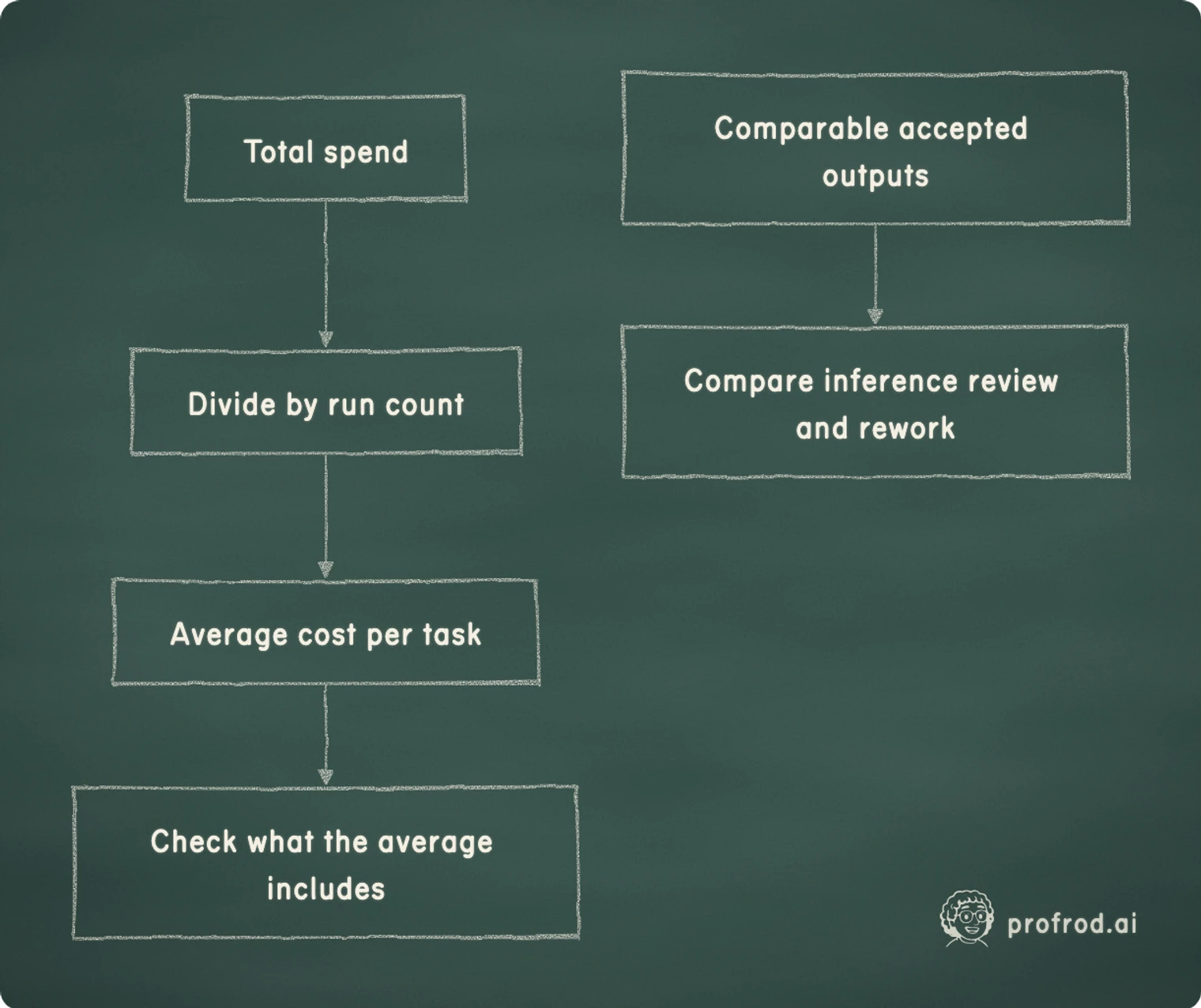
If your dashboard divides total spend by run count, inspect what that total includes: task calls, orchestration, retries and standing context may be mixed together. Using the resulting average for every task allocates those costs by volume.
Suppose one task needs a single call and another needs several calls plus a long review. A shared average hides that difference. Keep the observations separate before comparing routes. Standing costs change the picture too. If a fixed subscription is spread across fewer runs, its allocated cost per run rises even though the next run consumes the same resources. Cutting useful tasks in response raises that average again.
Tokens are the visible, metered part. Measure the other inputs before assuming they are smaller. Minimizing the metered factor because it is metered is looking for your keys under the streetlight. The companion essay on review queues applies the same arithmetic to a whole queue, where the acceptance rate is the variable that moves.
Cost attaches to a decision, not to a thing
When someone says "an agent costs X per task," ask which costs they included: marginal inference, subscriptions, orchestration or development. The same label can hide different accounting choices.
The missing discipline is attaching each cost to the level of decision that causes it:
| Level | What it carries | The question it answers |
|---|---|---|
| The task | tokens, the review minutes it consumed | should I run this one? |
| The stream | standing context, memory maintenance, monitoring | should this workstream exist? |
| The org / the period | subscriptions, orchestration, the tooling | what capacity should we hold at all? |
Scroll horizontally to view columns.
A task can pay for itself while the stream it belongs to does not cover its own readiness costs. Mixing the levels misleads in both directions: an allocated charge can make a useful extra task look unattractive, while a low incremental cost can hide expensive standing capacity. A workflow can be cheap to run once and expensive to keep ready.
Isn't this just Taylorism on the factory floor?
The objection is serious, and the answer is not obvious.
Frederick Taylor timed factory workers with a stopwatch, and the history of that is not kind to the people being timed. A dark factory has fewer people on the floor, but the ones it has are the reviewers, and the same concern applies to how a measurement of them gets used. A review-time record can show that a workflow creates extra checking. The same record can become a way to rank or pressure the people doing the checking. This essay argues for diagnosing the workflow, with the reviewers involved in deciding what is measured and how the record may be used. Logs may also contain personal or confidential data from the task; an agent's involvement does not remove the need to limit access, retention and content.
Use the record to ask which outputs create avoidable review and rework. Do not treat fewer minutes as proof of better judgment, or turn the record into a performance ranking. State the purpose and limits of collection with the people doing the review.
What smart people get wrong
What to actually track
Four fields per work product. A short manual record can be enough:
If your tool exposes usage, record it and what it includes: task calls, retries or orchestration. Mark missing usage as unknown. Do not substitute an estimate without labeling its assumptions.
Time spent reviewing, correcting and re-running. Keep these separate from token spend so a lower inference bill cannot hide extra work for the reviewer.
This is the p in the formula. Record it per task so you can compute an interval, not only an average.
Task, stream, or standing capacity. One word. It stops you mixing them later.
Why this matters in a lab
Labs price their models per token, and their customers turn that into a cost per task. An applied-AI engineer helping a customer choose a model is doing the calculation above, often without the review-time term. Leaving it out is the most common way a cheaper model gets chosen and turns out more expensive.
An interviewer could fairly ask: a customer wants to switch to a model that is three times cheaper per token. What do you need to know? A good answer writes down (c + R) / p, asks for the review time and acceptance rate on the customer's own tasks, and says how many paired examples it would take to tell the two rates apart.
What would prove this wrong
If review cost fell toward zero as fast as inference cost, for example because automated checks with measured, high agreement replaced most human review, the token price would matter again and this essay's emphasis would be misplaced. That is worth watching: a cheaper check lowers R for every model at once.
The book derives cost per task from prefill, decode and the way an agent loop resends its transcript.